Leaders Need to Learn How to Take Criticism…

If you’re in a leadership position, you need to know how to take criticism well. Being resilient will help you stay focused on what the company needs, rather than on the naysayers.

One strategy is to brainstorm several ways to respond to criticism and write them down for reference. It can be hard to know what to say at the moment, so general responses will ensure you have something ready. They could include: “Thank you for sharing your point of view. I’d like to consider it more and get back to you” or “Let me repeat what you said, to make sure I understood you.” Another good strategy is to remind yourself that the criticism may be aimed at your role rather than at you personally. If you’re the head of product, for example, it’s possible that the head of sales will always clash with you, no matter who has the job.

Distancing yourself from criticism this way can help you think through what was said — and what the criticism is really about.

Make Your Organization Change-Ready…

The best time to prepare for change is before it starts. But you don’t always have that luxury, especially when the future is uncertain and unstable. Instead you need to equip your organization to thrive in a state of constant change by reshaping its relationship to it. Here’s how:

  • Convey a different mindset. Don’t talk about change as something to be controlled and managed. Have an attitude that any change — good or bad, big or small, expected or unwelcome — is an opportunity for growth and improvement.
  • Conduct a “change audit.” Assess your organization’s readiness for a world in constant flux. Where is change hitting hardest in your organization? Which departments, functions, and teams have excelled despite the instability of the last 18 months — and why?
  • Assign someone to be responsible for your organization’s change-readiness. Depending on the size of your organization, it may be time to add a chief change officer whose cross-functional role is dedicated to helping the entire company prepare for a change-heavy future.

In-person work doesn’t always hold the advantages it’s often believed to…

As the hybrid era unfolds, the benefits of in-person work are increasingly misunderstood. To get the most out of your time together as a team, you need to be aware of the common myths about in-person work.

Myth #1: People learn more effectively in person. Because it rarely affords opportunities for meaningful practice and feedback, in-person learning is often less impactful than well-designed virtual learning. Make an effort to regularly design these types of experiences for your team.

Myth #2: In-person events help create (or strengthen) culture. Culture is built upon what your team experiences all day, every day at work—not what they experience when they step away from the normal routine for a workshop, keynote, or holiday party. Don’t depend on these outlier events; commit to building a healthy culture in the day-to-day, hybrid flow of things.

Myth #3: In-person gatherings are necessary to give people a break from screens. Healthy screen habits shouldn’t depend on where your employees are working from. They can—and should—be developed remotely, too. Encourage both your remote and in-office employees to unplug routinely.

Myth #4: Networking and human connection can only happen in person. False! People have long been able to develop meaningful relationships by writing letters and emails and speaking on the phone. Add video calls to that list.

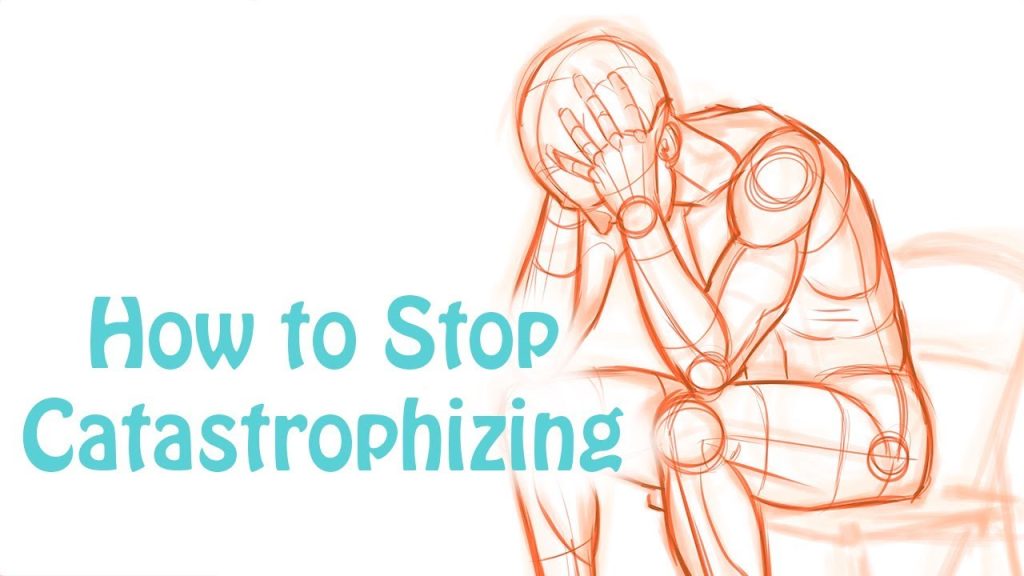
How to Stop Catastrophizing…

Leaders who create doomsday scenarios out of everyday setbacks—what behavioral scientists call catastrophizing—risk spreading their stress to their teams. If your catastrophizing is trickling down and getting in the way of your leadership, here are some ways to begin addressing it.

First, catastrophizing is a learned behavior, so be curious about how and when you learned it. Think about the formative seasons of your life when you started to foresee impending disasters. These stories may be painful to recall, but identifying the root of your habit is the first step toward interrupting it.

Then, interrogate the data you’re collecting. Ask yourself: What cues are telling you that the worst will happen? Are there circumstances, people, or challenges that regularly trigger your doomsday thinking? Are you fabricating fears based on past experiences? What positive data might you be ignoring?

To regulate your emotional state when you’re anxious about an outcome, first turn your attention to your physical experience. Simple changes to your breathing and environment can calm down your system in the moment.

Finally, acknowledge the consequences your catastrophic thinking has on others. As a leader, your mood sets the tone for your team. To maintain a healthy environment, acknowledge how your tendency to catastrophize might affect them. And, if necessary, apologize for your past behavior and talk about what steps you’re taking to grow.

Build a stronger work ethic for success…

Work ethic refers to a set of principles around work, such as reliability, productivity, autonomy, and ability to collaborate. While work ethic may come naturally to some people, it can also be learned and sharpened. Here’s how.

  • Develop self-discipline. This comes down to better understanding your impulses so you can manage them, creating systems to hold yourself accountable, and setting yourself up to have the energy you need to do good work.
  • Reset your priorities every day. Spend a few minutes in the morning identifying which items you need to get done. The trick is to find a balance between tasks that are urgent and must be finished today and tasks that are contributing to longer-term, but equally important, projects.
  • Be a team player. Collaboration doesn’t just increase the impact of your work and serve your team, it also demonstrates your dependability.
  • Own your work. Take pride in your to-do list. If something doesn’t make sense to you, don’t wait for direction—ask questions to get clarity. If you have an idea that you think is great, pitch it.

Plan your work relationships for career success…

As you advance in your career and climb the corporate ladder, your relationships with your peers are bound to get riskier and more complex; your collaborators can become, in many ways, your competitors. Here are three ways to effectively navigate these potentially messy — and critically important — relationships.

  • Don’t always expect friendship. While it’s important to be cordial, there’s a limit to how much emotional bonding is healthy as you ascend to the top. Keep it friendly, but maintain boundaries. Oversharing personal information can cause conflict and awkwardness in the long term.
  • Manage sideways. When you’re being considered for the executive ranks, leaders may ask your peers for their opinions about you. It’s often an informal dialogue and generally isn’t acknowledged as part of the formal performance review process, but it matters. So nurture your peer relationships, and stay attuned to how your colleagues experience you on a day-to-day basis.
  • Assess the political landscape. Candidly evaluate the behaviors that are rewarded in your organization. Figure out who gets promoted and why. Be strategic — broker mutually beneficial relationships with colleagues who are in favor and influential, and pursue mentors who make decisions and can sponsor your development.

Don’t Lose Sight of These Critical Leadership Behaviors

Consider this paradox: As you grow in your career, your brain develops in ways that undermine your ability to excel as a leader. Here are three essential leadership behaviors you need to commit to and protect as you develop professionally.

  • Being future-focused. The higher up the ladder you climb, the farther out you need to think. Resist the urge to value the immediate and short-term future over the long term. Rather than just ensuring the quality of today’s work, you must constantly scan for what’s next—and ensure your team is prepared.
  • Being good with people. As you accrue responsibility, it’s easy to give too much attention to high-level strategy and not enough to your relationships. Becoming a truly transcendent leader means finding a balance between technical and social skills and between goals and people.
  • Being able to drive realistic results. More power tends to make leaders more optimistic about what’s achievable. Make an effort to stay grounded: Pay attention to the data, details, and your employees’ perspectives and set sensible targets accordingly.

The best teams use these six tactics…

The best teams use these six tactics to separate substantive issues from personalities and resolve conflicts.

  • Focus on the facts – Arm yourselves with a wealth of data about your business and your competitors. This encourages you to debate critical issues, not argue out of ignorance.
    • Example – Star Fisheries’s top team “measured everything”: bookings, backlogs, margins, engineering milestones, cash, scrap, and work-in-process. They also tracked competitors’ moves, including product introductions, price changes, and ad campaigns.
  • Multiply the alternatives – In weighing decisions, consider four or five options at once — even some you don’t support. This diffuses conflict, preventing teams from polarizing around just two possibilities.
    • Example – To improve Triumph Computer’s lackluster performance, managers gathered facts and then brainstormed a range of alternatives, including radically redirecting strategy with entry into a new market, and even selling the company. The team combined elements of several options to arrive at a creative, robust solution.
  • Create common goals. Unite a team with common goals. This rallies everyone to work on decisions as collaborations, making it in everyone’s interest to achieve the best solution
    • Example – Start Electronic’s rallying cry was the goal of creating “the computer firm of the decade”. Premier Technologies’ was to “build the best damn machine on the market.”
  • Use humor. Humor – even if it seems contrived at times — relieves tension and promotes a collaborative spirit within a team. Practical jokes, Halloween and April Fool’s Day celebrations, and “desert pig-outs” relax everyone – increasing tactfulness, effective listening, and creativity.
  • Balance the power structure. The CEO is more powerful than other executives, but the others wield substantial power as well — especially in their own areas of responsibility. This lets the whole team participate in strategic decisions, establishing fairness and equity.
  • Seek consensus with qualification. If the team can’t reach a consensus, the most relevant senior manager makes the decision, guided by input from the others. Like balancing the power structure, this tactic also builds fairness and equity.

Don’t tell them show them…

Telling is different from showing, when you show it’s visual whereas telling is dull.

Telling – Ravi went to fetch water from the well.

Showing – Ravi, picked up his old socks and shoes, with a stained red mark from the previous night’s adventure, wore them, and then took a bucket. While marching on the muddy road to fetch water from the nearby well.

When you are storytelling you are visualizing things and it’s important that your audience also visualize it, because even a trivial visualization gives the audience the connection and liveliness as if they are living through that memory.

And that’s the difference between a great communicator and a mediocre one. So next time whenever you are communicating either through presentation, email, or talking to a group, try to do it visually with words rather than just telling.

How to improve your presentation immediately…

Follow these rules to immediately improve your presentation.

  • Make slides that reinforce your words not repeat them.
  • Create slides that demonstrate, with emotional proof, that what you’re saying is true, not just accurate.
  • No more than six words on a slide. EVER.
  • Don’t use cheesy images, use proper stock images.
  • No dissolves, spins, or other transitions. Keep it simple.
  • Surprise them – Put up a slide that triggers an emotional reaction in the audience. Let them sit up and want to know what you’re going to say that fits in with that image.