I forgot to ask this question in my first job…

Build skills or Build relationships?

If you build skills it goes a short way. Skills change, skills need an upgrade otherwise will make you obsolete.

If you build relationships it goes long way. You know people, you know how to use skills thru them, and you can build a future with them.

Choose wisely – You cannot build relationships later but can build skills.

Ask this question at every job and every step in your career.

Build Your Emotional Courage…

In today’s environment, it’s imperative to handle things that make us feel uncomfortable. Maybe you have to say no to a noisy colleague or avoid going to a party with friends, or say no to a family friend. You may also need to raise a challenging issue with your manager or peer. 

To improve the way you deal with uncomfortable situations, build your emotional courage. Start by thinking of what kind of skill you want to get better at, giving feedback, listening, being direct — whatever you want to grow in. Then practice that skill in a low-risk situation. For example, let’s say you want to get better at being direct. The next time there’s a mistake on your phone bill, call customer service and practice being succinct and clear. Notice how you want to react — Get angry? Backpedal? — and focus on resisting those impulses. 

In summary, practice your emotions in low-risk situations and get used to them. These are the same feelings you’ll encounter in higher-risk situations at work, so learn to push through them. Continue to practice until you feel comfortable and can respond the way you’d like to.

Feeling insecure, make yourself valuable…

In today’s environment where job security is a big concern whether you are in FAANG (Facebook, Amazon, Apple, Netflix, and Google) or a startup or any other tech company. It feels insecure to be in the current situation and nudges us to somehow make ourselves indispensable.

At the same time making ourselves indispensable in an organization might bite back. By making yourself too irreplaceable you could get stuck in the current role and stymie your career development. Which could become scarier.

So what steps you should take?

Focus on what you can control. 

Start with small steps. First, understand your strengths and reevaluate where they can be applied at the individual level, team level, and current organization level. Be frank with yourself and your manager (If you have a supportive one). Maybe volunteer for work which excites you even though it is beneath your grade or level. This will help you build confidence and reduce stress.

Team-first growth mindset.

Instead of trying to make yourself irreplaceable, focus on making yourself a valuable member of your team. In other words, rather than becoming a gatekeeper or the only go-to person for a specific process, search for new opportunities to help everyone. Be proactive about adapting your responsibilities—and adopting new ones—to meet the team’s changing needs and goals. Don’t wait to be asked. You might notice, for example, a leadership gap in certain meetings, or a process tweak that would make everyone’s lives easier. Step up to help fill the void. 

Look for opportunities within the company.

Also, look for opportunities to contribute that take advantage of your unique strengths. Ultimately, your goal is to become an integral member of your team and your company, rather than just a high-performing solo operator. 

If you supplement your role-specific expertise with this team-first growth mindset, you’ll be on your way to your next promotion or at least be safe in the current turmoil.

Practice self-compassion. 

In the end, whatever happens…happens, you keep giving your bests. And be extra gentle with yourself. Reconnect with people you love outside of work. Spend quality time with them to brighten your mood, alleviate tension, and remind yourself how you deserve to be treated.

Sudden Job loss, Embrace Feeling “Torn”

Inflection points in our career (like an opportunity or job loss) often evoke feelings of ambivalence: the experience of positive and negative emotions at the same time. Ambivalence can feel uncomfortable, but you can use it to your advantage when faced with a big decision. 

Start by taking time to reflect. Approach your complex feelings with curiosity—not judgment—to identify what you feel and why. You might ask yourself a series of questions to unpack your feelings and jot down some notes. 

Make sure to relieve some pressure—if you can, give yourself a deadline that isn’t in the immediate future and allows you to devote time and energy to listening to your emotions and considering your options. 

Finally, remind yourself that nothing is permanent. Whatever you decide, it’s just “for now.” The beauty of most career decisions is that they’re often reversible, or at least recoverable, and there will always be another chapter to your career down the line.

Not Feeling Ambitious?

We all think of ourselves as high achievers, but sometimes, it happens that we haven’t been feeling that usual spark of ambition. It might be because of burnout, because of a life-changing event, or a midlife crisis. Is this wrong? Absolutely not! 

But we need to make peace with the desire to tone it down—even if that impulse conflicts with our previous vision of ourselves. Here are a few tactics that can help;

Adopt a flexible mindset.

First, adopt a flexible mindset, and let’s recognize when it’s time to shift to another strategy. This could mean acknowledging that it may be time, after years or decades of grinding hard at work, to reallocate energy toward your health and happiness, family, or hobbies and passions outside of work. 

There are no timelines in Career.

There is no standardized timeline. How does it matter if you have attained your goal in 10 years or 15 years, in long run it does not. Your career is a marathon; give yourself the grace to slow down sometimes, take mental breaks, and pace yourself. 

How to grow yourself.

Finally, figure out what you need in order to grow. Moving forward isn’t always a function of getting a raise, making new professional connections, or building your resume. Sometimes it’s a function of changing things up and exposing yourself to new inputs—whether it’s a month-long trip abroad or a year of stepping back from the grind mentality and focusing on other areas of your life and well-being—that eventually lead to new and different outputs.

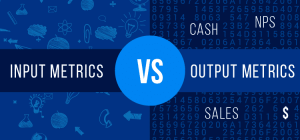
Input Metrics vs Output Metrics…

Our end goal metrics are output metrics, for example – Revenue, Cash inflow, Traffic, or No. of Active users are output metrics.

Input metrics are controllable metrics that drive these Output metrics.

If traffic is your output metrics then input metrics can be “no. of quality content posted in regular intervals”. 

For revenue, “no. of qualified lead calls per day” can be input metrics.

There can be different input metrics to achieve the same output metric. 

Also, we have control over output metrics only thru input metrics. To control output, we must understand how inputs affect the outputs of the system. And which one to use for achieving our output metrics.

Moreover, it’s not just “no. of content” posted per day. We identified no. of quality content posted per day. The “Qualifier” is critical because we don’t want any “content” we want “quality content” that can engage users and also in regular intervals daily, weekly, monthly, etc. So both the qualifier and interval are critical parts of the input metrics.

In general, our plans be it for external or internal teams are for output metrics; revenue, users, etc. But unless we break it into controllable input metrics and put targets for input metrics, we will not be able to achieve our output metrics.

Identifying Input metrics is hard because what seems obvious can lead to different output metrics or may not even achieve it. It takes time, analysis, and hard work to really understand and identify the core input metrics. And that’s what creates a big differentiator between successful and unsuccessful companies.

A successful company has more clarity on input metrics and how it drives output metrics.

Monday blues…

When I was in working as an employee, I use to always envy entrepreneurs, business owners & promotors. They never seem to have Monday blues, I use to hate Mondays. 

I am sure most of us who work in job or are employed hate Monday’s. 

So what is “Monday blues”? 

It’s a sad and melancholy feeling, starting from Sunday evening, that the next day is very stressful. Meetings, expectations, status reports, team confrontations, and never sure what kind of surprise waiting for you on Monday. In-fact sometimes we dread this feeling so much that we find reasons to skip work that day if possible. But can’t!

So how did I got rid of Monday blues? 

I came out of these Monday blues, I am running my own startup for the last couple of years. And sometimes when I remember how I got rid of Monday blues, I laugh at myself.

A simple answer is I made every day Monday, :(. Sorry to disappoint u! But there seems to be no other way. 

As a Co-Founder, every day is a Monday with lots of stress. Days are not so different now, be it Sunday or Monday or Tuesday, every next day is going to be a blue day. Yes once in a while you have golden days but those are few counted once.

It’s like to kill fear, be with fear, and u will get use to the fear.

Unfortunately, there is no other way to kill Monday blues, unless you run off and live the life of a saint alone in forests.

So enjoy your Monday blues, and be grateful you got only one blue day in a week :). 

Tips to Reduce Screen Time While You’re WFH…

It’s exhausting to look at a screen all day. And yet, if we’re working remotely, it may feel unavoidable. To maintain our energy throughout the workday, let’s try to proactively disconnect from screens whenever you can.

Here are a few tips that can help:

Avoid Video calls if possible – Remember that video calls aren’t necessary for every meeting: Let’s try a regular phone call every once in a while to mix things up. Also, choose physical over digital whenever possible.

Use Pen/Paper if possible – Brainstorming ideas for an article? Write out your thoughts on paper or post-it notes. Creating a road map for a big project? Sketch the initial draft on a whiteboard or butcher paper instead of typing in a laptop.

Move around as much as possible, even if it’s just standing up and rolling your shoulders or grabbing a glass of water between meetings, take frequent breaks.

Take tech-free breaks over lunch, tea time, and find activities that don’t involve a screen to wind down.

Taking these steps will help us reduce our digital fatigue and feel more energized at the end of each day.

Work Stress Keeping You Up at Night…

Work stress is inevitable, but it doesn’t have to get in the way of a good night’s sleep. Try these strategies during the day to avoid worrying about work at all hours of the night.

Make a to-do list. The act of writing down uncompleted tasks allows us to put them out of mind.

Keeping a journal, where you write down thoughts and feelings. Putting pen to paper can help process emotions and reduce anxiety.

Get some exercise. Physical activity — even a single instance — decreases rumination, which is often linked to insomnia.

Practice meditation. Researchers have found that even small amounts of mindful meditation (10 minutes before and after work for two weeks) helped calm racing minds and improved sleep quality and duration.

Lastly, be easy on yourself. Self-compassion can often break the cycle of negative thoughts that keeps you up.

Work stress may be inevitable at times, but these strategies can increase our ability to wake up feeling refreshed and able to tackle the biggest challenges.

Decide Your Meeting Agenda Before…

A good agenda is the first step to any successful meeting. If you want to make the best use of everyone’s time, turn your bullet points into questions that drive to the outcomes you’re looking for.

For example, instead of a general topic like “Budget Problems,” try a specific question like, “How will we reduce our spending by $100,000 by the end of the fiscal year”? Or replace an item like “Strategic Planning” with a challenge like, “What is the key market threat we need to be aware of, how could it affect us, and what can we do to anticipate?” Preparing these questions before the meeting will make it easier to determine who should be there and how much time you’ll really need.

Ultimately, a questions-based approach to your agenda can bring focus, engagement, and better performance to your meetings. And if you can’t think of questions to ask, maybe you don’t need that meeting after all!