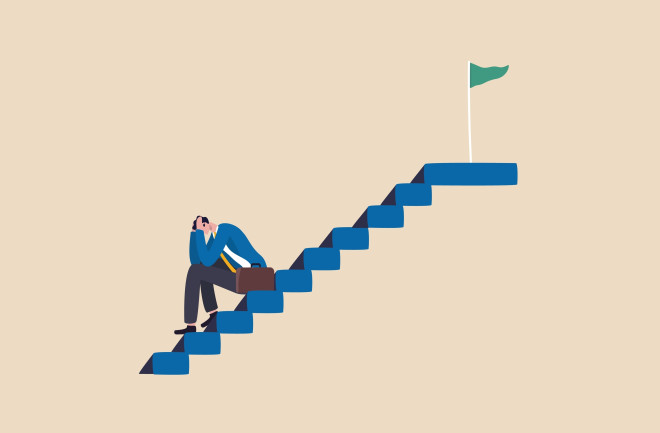
Get More Comfortable with Failure…

We’ve all been there: you make a New Year’s resolution and…it doesn’t stick. Why? It’s often because we don’t allow ourselves to be bad at it at first. We fail a few times and then decide to give up. But adopting any new habit is going to feel clunky at first. 

The key to taking on something new is to get more comfortable with failure. Here’s how.

Start by immunizing yourself against big letdowns by trying out experiments that allow you to fail in tiny ways. For example, if your goal is to write every day, start by committing to one short paragraph each morning. If you don’t like what you write, no big deal! It’s just a paragraph. Write another one tomorrow.

Next, make your goal known to others before your self-doubt creeps in and you chicken out. This layer of accountability will help you actually follow through on your goal — no matter how bad you are at it the first time.

And finally, keep a log of your efforts. Over time you’ll notice how far you’ve come. Rather than focusing on the small, inevitable failures, you can appreciate your overall progress.

Stop Overthinking Big Decisions

Thoughtful deliberation is an essential leadership quality that can help you make better decisions and produce better outcomes. However, it can also devolve into overthinking, which can be paralyzing. Here are three ways to avoid a thought spiral that can slow you down:

  1. Curb your perfectionism. Perfectionism is one of the biggest blockers to swift decision-making because it operates on faulty all-or-nothing thinking. To curb this tendency, ask yourself questions like: What’s one thing I could do today to bring me closer to my goal? Or what’s the next step based on the information I have right now?
  2. Pay attention to your intuition. When it comes to difficult decisions, your gut reaction is often a critical data point, particularly when time is short or you don’t have all the information you need. Research shows that pairing intuition with analytical thinking helps you make better, faster, and more accurate decisions and gives you more confidence in your choices than relying on intellect alone.
  3. Construct creative constraints. Determine a date or time by which you’ll make a choice. Put it in your calendar, set a reminder on your phone, or even contact the person who’s waiting for your decision and let them know when they can expect to hear from you.

Inspiration from Mr. Jha

Mr. Jha is a cancer patient who lives in our locality. And while I have seen in movies these kinds of inspirations it’s the first time I have seen it so close to me.

When I first met Mr. Jha in our community badminton court, he was the most jolly person I have met. With his round eyes, big round cheeks, bald head with white hair in patches, and always-ready smile, the most prominent of all was to make everyone around him laugh. Although his age would have been the late 50s you would get an impression of a younger person because of his energetic exuberance.

When I met him after the cancer treatment and while he was recovering, it was a shock, the man was looking like a stripped-down version of himself, with hollow cheeks, a bald head, and a half-grown stubble around the face, still, the smile remained, and what remained is his jolly nature with the power to still make others laugh.

Yes, the treatment deteriorated his body but still, the man and his soul remained unperturbed. He is a real inspiration to all of us who are saddened even in small matters. We feel let down even if a small thing doesn’t go as planned and a quick blame to throw at everyone around us.

The biggest lesson for me is to live a happy life with smaller things and if things are changing consider it to be changing for good around you. And if there are things not in your control, be happy, accept it, and move forward.

Two Ways to Leave Work Stress Behind

After a long day, it can be a struggle to leave work behind you. Too often, we take out job-related stress on our friends, children, or partners. Here are two ways to make sure your work troubles stay at the office:

  • Have an end-of-work habit. Signal to your brain that it’s time to go home with a ritual that helps you unwind. Take a more scenic route home, listen to music on the bus, or go to the gym. Make time for this habit so you can switch gears before you get home, not as you’re walking in the door.
  • Create a third space. It’s easy to just shuttle back and forth — physically and emotionally — between work and home. But having a third space besides these two locations will help you decompress. It might be anything from a quiet café to a book club to a poker night. It should be a place where you explore your interests, relax, and ideally find fulfillment.

Are you running blind…

Do you know what you want in the next 6 months of life? Probably Yes.

How about what you want in the next 2 years? 3 years? 5 years?

Whether it’s an individual or a company if there is no long-term vision i.e. we don’t even know what we want it’s impossible to get it.

It’s like running blind for the next 10 meters after which we don’t know whether we will hit a wall or go down a pit.

Hence try to think about the years ahead, it’s difficult but with practice, you can start envisaging the future.

And as they say, if you can dream what you want, it will mostly come true.

Start Your Day with Silence

We live in a world full of noise and chatter, and it can be hard to find a break from it all. If you’re feeling overwhelmed, give this mindfulness exercise a shot. It’s called the Sphere of Silence, and it’s a 60-minute routine to help you collect your thoughts, stay grounded, and decide how you want to enter your day. There’s one important ground rule: Complete the steps below in silence.

  • The first half hour is broken down in three 10-minute segments. Spend the first segment writing your short-term, medium-term, and long-term goals. Then, dedicate the next 10 minutes to assessing your progress on your goals from the previous day. Use the final 10 minutes to take note of unmet goals and assess why you haven’t achieved them. This will motivate you to focus on moving forward.
  • Spend the next 10 minutes reading something — an article, a book, maybe even a poem — that teaches you something new or enriches your mind.
  • Then, spend 10 minutes writing. Maybe you’ll jot down a reaction to what you just read, or a poem of your own.
  • Use the final 10 minutes for self-reflection. This part of the practice allows you to harness your calm during stressful situations and mindfully choose to stay out of negativity.

Get up and dance…

Get up and dance to the tune to learn and succeed. 

Yes, you will feel shy,

Yes, you will feel uncomfortable,

Yes, you will fail,

Yes, you will want to save your face,

But without the dance, nothing will ever happen. 

So imbibe it, learn it, and be good at it.

Because more than the dance sometimes it’s the effort to get up and dance counts.

Are we impacting…

Sometimes in the race, we forget to ask,

Are we making an impact? 

To our life, to other’s life, to any life at all? And is the impact good or bad?

Whether the impact is on your family, peers or subordinates.

Let’s try and make a positive impact in other’s life.

Shallow work vs. Deep work…

Shallow work kills you, it keeps you busy without taking you anywhere.

Deep work enthralls you, it keeps you on your toes with childlike curiosity.

Shallow work is easy to achieve, you can do multi-tasking giving a false sense of success.

Deep work is hard to achieve, you can solve big problems once in the zone.

Shallow work at the end of the day tires you as you have lifted many tons of weight with no output.

Deep work at the end of the day makes you happy, and joyful and lifts up your spirits.

Fight for Deep work and avoid Shallow work.

Casual vs. Due Diligence

Casual efforts alone rarely lead to success. While informal discussions with friends can be a wellspring of inspiration, they’re just the starting point for you. Without the subsequent application of due diligence—rigorous research and committed effort—ideas remain nothing more than potential. It’s crucial for you to remember that generating ideas is merely a fraction of the journey toward accomplishment. What truly sets you apart is not just the novelty of your ideas, but your capacity to apply diligence.

Valuing yourself for more than just generating casual ideas is crucial. Instead, recognizing the significance of your diligence and dedication to the task at hand is what truly distinguishes you. This emphasis on thoroughness ensures that ideas aren’t just left in the realm of thought, but are pursued and realized, ultimately leading to meaningful success.