Challenging people to grow is ultimately an act of kindness…

When someone’s reporting to you already doing well, you might fear that pushing them to do more could be discouraging or demotivating. 

Instead of shying away from these uncomfortable conversations, reframe them as an indication of true care. 

Stretch people to see their potential. Later in life, they will be thanking you to make them what they are by stretching and getting out of their comfort zone.

Want to Create a High-Performing Employee?

Every leader wants to create or convert a low-performing employee into high performing. One piece that’s often missing is the importance of social connections. If you’re trying to supercharge a person, here are research-backed ways you can foster greater connectedness:

Invest time in bonding over non-work topics. 

The best way to instill trust and emotional attachment is to bond over personal topics. In fact, discussing things not related to work — sports, books, and family, for example — reveals shared interests, and allows connecting in genuine ways, which yields closer friendships and better relationships.

Openly appreciate expressiveness.

Recognition is often a more powerful motivating force than monetary incentives. And an acknowledgment of being expressive not just work should be the norm. It allows her the open up with you and the team boosting her self-confidence and trust.

Put a premium on authenticity. 

It’s important to create an environment where employees feel comfortable candidly expressing both positive and negative emotions — as well as complimenting and joking with teammates. This kind of environment has an inductive effect on lower-performing employees and they start performing well. 

Structure or Details…

To communicate would you choose structure or details? Off-course both complements each other but which one to choose as starting point?

Structure defines the flow and Details fill the flow. 

If it’s formal communication whether presentations, business meetings, or interviews, the “Structure” is necessary – it’s a way to simplify complex communication between professionals. 

If it’s informal communication between friends or colleagues “Structure” kills casual relationships whereas “Details” bring the story. 

So choose wisely.

Help Out Introvert(s) on Your Team…

Chances are, more than a few of your employees are introvert(s) and sometimes feel out of place—regardless of how competent they are. They are part of your team and they high performing employees. But sometimes being introverted comes their way to perform. As a manager, how can you help them?

Watch for red flags. 

Unsustainable work habits, such as constantly working long hours, can be a telltale sign. To prove themselves, introverts will work long hours, as they feel they’re not contributing enough. So can disengage work habits, such as withdrawal from a social group, and hesitancy to ask questions or speak up. In either case, start an honest dialogue with your employee early. Proactively ask if a sense of self-doubt might be underlying their behavior.

Focus on their work. 

Acknowledge high-quality work and signs of development. Positive feedback builds confidence and helps dissipate insecurity which is sometimes the cause of being introverted. If they make mistakes, emphasize that this is an integral part of learning.

Be vulnerable. 

Share some of your own professional or personal insecurities and failures, particularly those failures that you overcame in a meaningful way. This will remind them that what they’re feeling is normal—and that they can overcome it.

Be an Active Listener to be a Good Manager…

If you are managing a team, the ability to listen, effectively break down, and analyze an issue in order to find a solution — will be core to your success. Whether it is an internal team issue, a technical issue, or an external dependency. 

Being an active listener and ability to formulate effective questions to get others to open up is crucial. Here are a few ways to boost your ability to do this.

Hold your hypotheses loosely, Don’t be defensive.

Approach any problem with an open mind, and hold any of your hypotheses. Asking good questions can lead you to fundamentally reconsider your assumptions — but you have to be willing to do so without defensiveness.

Listen more than you talk. 

Active listening allows you to fully grasp another point of view, making it easier to question your own assumptions and biases.

Leave your queries open-ended. 

Avoid asking yes-or-no questions. Instead, try to get the respondent to open up at length.

Consider the counterintuitive. 

Every group has someone who’s unafraid to challenge the status quo, sometimes he/she is the right person to discuss any approach or any conclusion you are formulating.

Sleep on it. 

A good night’s rest can actually help your brain see a problem more clearly, be more attentive to others, and hence be able to resolve any issue faster.


How to Delegate Effectively in a Way that Delivers What You Want

As a manager, you can’t have your hand in every single project. That’s why you need to delegate. But too often, people pass on poorly defined tasks and responsibilities and aren’t clear about their expectations, leaving the person on the receiving end to sort out a mess. 

Be as clear as possible.

If you want to delegate effectively, first take the time to think through what success would look like. Then communicate clearly with your colleague about what you are hoping the outcome of the work will be. Do you have something specific in mind or is there a range of acceptable results? Explain how you will evaluate both progress and the end result and whether there are certain milestones the person should hit along the way. 

Show how the task fits the larger goal.

You also want to clarify how the task you’re delegating connects to your team’s larger goals. If it’s one small part of a project, for example, explain how it fits into the whole. 

Ask for a summary of delegated work.

Once you’ve done all that, ask the person to sum up what they heard you request. You could even ask them to send you a summary in an email so that you capture their understanding — and correct it, if necessary. 

Taking these steps will help you delegate in a way that delivers the results you’re hoping for.

Do you Micromanage?

Micromanaging—being overly prescriptive or following up too much—is a surefire way to demotivate your employees and rob them of learning opportunities. 

Here are a few ways to ensure you’re not being a micromanager.

Set clear expectations on outcomes, not process. 

The next time you assign a task or project, describe the outcome you want—not every step you want the person to take along the way. The goal here is to give them the autonomy and space they need to step up and get the job done.

Give feedback as per the process.

At the start of each new project, discuss when and how you’ll give constructive input. This will allow you to step in and redirect the flow of the project whenever necessary—without being overly involved or catching your team off guard.

Team exposure to management. 

In conversations with your own boss, talk about your team—how you’re helping employees grow, places they’re stepping up and shining, and what your plan is for the long term. This will help you build trust, demonstrate competence, and remove some pressure that leads to micromanaging push from the top management. 

Are you satisfied with your career success…

How do you define your career success, even with all the achievements we rarely pat our backs and say we have done well.

So, why does career success so rarely lead to satisfaction? If you’re prone to dissatisfaction in moments when you expect to finally feel satisfied (after a raise, promotion, or award, for example), you can shift your mindset in three ways to achieve a more sustainable inner peace. 

Stop counting – First and foremost stop counting what you’ve accrued (money, awards, followers, etc.) and start measuring what you’ve contributed (Whose life have you positively impacted? What ideas have you generated?). Lasting joy comes from giving, not taking. 

Comparison to Compassion – Secondly, start by shifting from comparison to compassion. Rather than chiding yourself for what you haven’t achieved, show yourself kindness for the progress you’re making on your own journey. And instead of resenting someone for what they’ve achieved, acknowledge that their success doesn’t come at the expense of yours—they’re on their own journey, and being happy for them won’t cost you anything. 

Contempt to Connection – Finally, shift from contempt to connection. Growing insatiably ambitious, no matter how much money or power you earn along the way, will lead to bitterness and loneliness. Remember to appreciate the relationships in your life—especially the ones that have nothing to do with your career success.

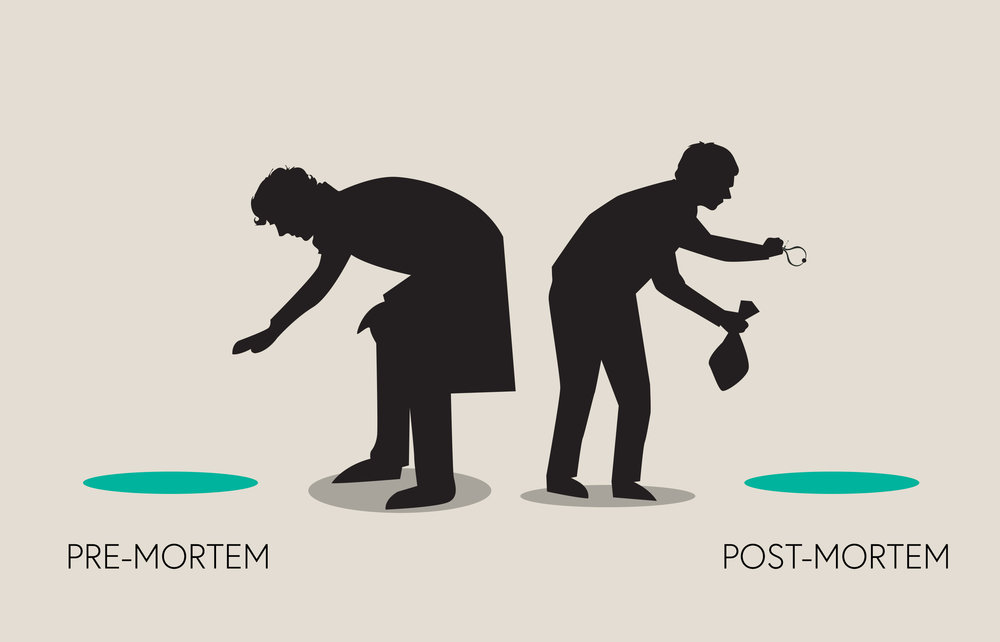
Pre and Post Mortems…

Learning about the past and inspecting the future is critical for any project. Pre and Post Mortems help us do that very effectively.

Pre-Mortem

These conversations are used to help identify and mitigate risks for specific projects, goals, or initiatives upfront. Ask your team: How can we make sure we enable the drivers that will contribute most to our success? How can we address or mitigate risks that could cause us to fail?

Post-Mortem

This is a chance to step back, take a more objective perspective, and challenge the team’s assumptions. First, focus on your successes. What went well, and what was the impact of these things going well? What behaviors, factors, or conditions contributed to their success? Then shift to failures or shortfalls. What didn’t go well, and what was the impact of these things not going well? What behaviors, factors, or conditions led to that outcome? How can we avoid these issues going forward?

Am I hard to work for?

Nobody wants to be a bad boss. Here are a few questions to help assess whether you are difficult to work with as a boss.

Are your standards unrealistic? 

Expecting excellence isn’t a bad thing. But if your standards are too high, you’re setting your team (and yourself) up to fail. Consider whether you have perfectionist habits that frequently impact your team. 

Are you a micromanager? 

Do you tell your employees exactly how things should be done, leaving no room for creativity or initiative? If so, shift your focus to outcomes. You can provide feedback and guidance along the way, but leave the process and execution to your team. In other words, don’t do the work for them.

Do you only delegate busy work? 

Everyone wants to grow, and if you raise the bar and let go of a little control, you will be surprised by how people respond. Use delegation as a tool for development.

Is your feedback overly negative? 

Aim for a 6:1 ratio of positive to negative feedback. If you don’t often deliver positive feedback, start by acknowledging your employees’ strengths and successes in a specific and timely way.

Ask these questions frequently and keep improving to become a better boss and manager.