Reduce Your Vulnerability to Layoffs…

What should you do if you’re working under the cloud of impending layoffs? You can’t always control the outcome. But you can reduce your vulnerability by understanding the most common reasons people get laid off and how to defend against them.

  1. A lack of skills advancement. Employees who don’t keep up with rapidly changing business needs may be a target. It’s crucial to take a proactive approach to developing your skills based on where the market and company are heading.
  2. Being an overseer, not a doer. Managers who lack hands-on involvement may be perceived as not directly contributing to execution or outcomes. To become invaluable to your organization, find a balance between strategic leadership and direct involvement in work (without micromanaging your team).
  3. Being invisible. If senior leaders don’t know who you are or what you do, your job could be an easy target. Investing in relationships and visibility can help mitigate this risk.
  4. Offshoring and automation. To safeguard against these threats, it’s critical to stay informed about market trends and assess whether your chosen career is prone to displacement or replacement in the future. If so, you can take early steps to shift paths.
  5. Underperforming. Your manager’s perception of your work is everything. If you suspect they’re not satisfied with your contributions, request feedback and regularly check in to see whether they agree that your performance has improved.


Moving from Territorial to Collaborative Leadership…

Do you feel the need to compete with your peers for people, investments, and attention? This individualistic, “fend for yourself” approach to leadership may serve you early in your career—but it can have diminishing returns. To reach the next level, you need to redefine winning as a shared goal. Here’s where to start.

Build self-awareness. Start by deconstructing why you feel the need to be competitive or territorial. What story are you telling yourself about your colleagues and organization? Once you understand the assumptions underlying your behavior, you can challenge them.

Move from a “me” to “we” mindset. To do this, identify which colleagues are critical to your success in the near term. Then determine the actions you must take to move the relationship forward and achieve mutually beneficial outcomes.

Rebuild trust. Collaborative leadership requires healthy, trusting relationships. Be authentic with your coworkers, showing sound logic and competence. Establish a shared commitment to help them advance their goals, as well as your own.

How to Stop Ruminating…

It’s totally normal to ruminate on stressful situations, whether it’s a nagging problem at work or a personal conflict that’s making you anxious. The good news? Improving your ability to stay present can help you set aside stressors that you can’t immediately resolve. Here are some strategies to break the cycle of rumination.
 
First, anchor yourself. Take a moment to feel the weight of your feet on the floor, then consider: “What am I thinking? What am I feeling in my body right now? What am I doing right now?” Then ask yourself: “Are my thoughts helping me in this moment?”
 
Then try to take your thoughts less seriously. Rather than allowing negative ideas to feel like dictators in your life, gain some perspective by observing them from a distance and reminding yourself that they’re just thoughts.
 
Next, don’t fight uncertainty. While accepting uncertainty might mean sitting with some amount of fear, the alternative is to try to micromanage reality, which simply isn’t possible. 
 
Finally, validate yourself and what you’re feeling. Simply legitimizing your negative emotions can help diffuse stress and rumination. For example, you might think something like: “I have the right to feel nervous.” Naming an emotion—and giving yourself permission to feel it—can help you move past its initial intensity.

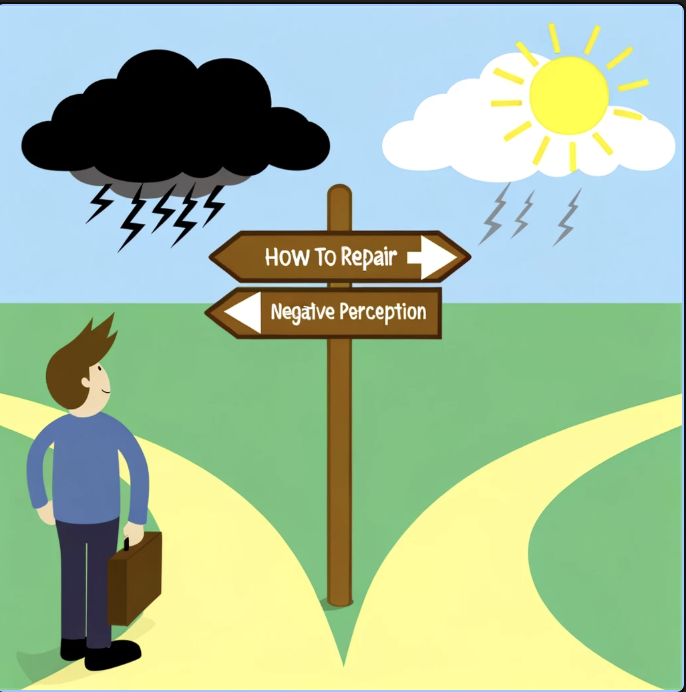
How to Repair a Negative Perception of Your Work…

Learning that others’ perceptions of you or your work don’t align with your own can feel destabilizing. But as difficult as it is to hear, learning how others view you can provide an opportunity for self-improvement and professional growth. Here are steps you can take to repair a negative perception of your work.

Reflect on the feedback. First, acknowledge your immediate emotional reaction. Then try to distance yourself and objectively assess the feedback as if it were about someone else. Then ask yourself: If 2% of the feedback were true, what actions would I take to change the perception? And how much effort am I willing to put in to do it?

Actively listen. Reach out to various colleagues you trust. Express your desire to continually improve, and ask for additional honest feedback. Keep it simple with these four questions: What do I do really well? What should I continue doing? Where can I improve? What should I stop doing? The goal is to listen actively and write down what’s said—without commenting or getting defensive.

Acknowledge misunderstandings or misbehavior. Apologizing for your part in any misunderstandings or shortcomings can go a long way in changing others’ perception of you—as long as you also ensure that you don’t repeat the behavior in the future.

Seek support and use talent development tools. Look to your manager or HR for resources to support growth in the competencies you’re trying to improve, and keep track of your progress with your manager over time.

Are You Addicted to Your Phone?

Has your smartphone use become problematic—affecting your family time, social life, or work? Interrupting an unhealthy relationship with your phone starts with developing self-awareness. Here are the red flags to look out for and questions to help you spot them.

Loss of control. Do you feel a deep, persistent, and uncontrollable urge to check your phone, even when you’re not waiting for anything in particular?

Dependence. Do you feel anxious or irritable when you have to turn off your phone? Are you preoccupied with the thought of missing a call, text, or notification?

Emotional coping.  Do you reflexively turn to your phone to cope with negative emotions like boredom, frustration, stress, or social anxiety? 

Negative emotions. Simply put, does being on your phone make you feel bad? Do you feel more stress, anxiety, or loneliness after using it?

Harmed social relationships. Does using your phone prevent you from listening to others and engaging in uninterrupted, face-to-face conversations? Do important people around you feel neglected because you’re focused on your phone instead of them? 

Compromised performance. Does your phone distract you from getting important things done? Limit your ability to think clearly. Enable your procrastination?

Listen to Your Burnout…

No two experiences of burnout are exactly alike. To recover, you first need to understand what your burnout is trying to tell you. Here are three common messages your burnout might be trying to communicate—and what to do about them.

You’re expected to over-index on work. Research has consistently shown that chronic overwork leads to a decrease in productivity, higher absenteeism and turnover, poorer health, and yes, burnout. If this is your experience, it’s time to invest in your rest and recovery, communicate and maintain your boundaries regarding when you are—and are not—available, and resist the temptation to check in after work hours.

You’ve outgrown your role. While overwork is a well-known cause of burnout, feeling chronically underutilized can also be a culprit. If you’re persistently restless, bored, directionless, disengaged, or not challenged at work, it’s likely you’ve outgrown your current role and are ready for a new chapter. If this is the case, do some self-reflection: What career would make you feel rejuvenated? Identify some possibilities, then take the first step in pursuing them.

This job is not what you signed up for. Do you feel a disconnect between what you expected when you were hired and what you actually experience at work? Pinpointing the exact misalignment is the key to resolving it. Is it your workload? Your day-to-day responsibilities? Your work culture? Your compensation? Once you’ve identified the problem, work with your manager to address it.

You Can Develop Your Soft Skills—Even When You Work from Home…

In the age of AI, soft skills like empathy and creativity are more important than ever. But they can be a challenge to develop when you work from home. How can you build soft skills when you’re interacting with your colleagues over Slack and Zoom all day?

First, establish shared values and norms in one-on-one conversations. Start small by asking your colleagues about their work preferences, like when and how they like to communicate. Then go deeper, asking about their underlying motivations and passions.

Then make colleagues feel seen and heard. Use idle time in meetings to show genuine curiosity in your colleagues and practice your listening skills. Don’t be afraid to deviate from the agenda from time to time to have conversations about life outside of work.

Next, because you’re not getting the same on-the-fly coaching that comes with in-person interactions, you need to proactively seek feedback from your team and manager. This could take the form of scheduled check-ins or asking for immediate impressions after meetings.

Finally, seek out some in-person time. Even if you’re primarily a remote worker, finding ways to see your colleagues in person occasionally is an investment in your professional development. 

The Right Way to Raise a Difficult Issue with Your Boss…

Raising a potentially emotional topic to your manager can be hard, especially if you’re uncertain of how they might respond. Whether you’re experiencing difficulties with a colleague, health issues, or feeling burned out, here’s how to raise the issue with your boss in your next one-on-one.

First, consider whether your manager can actually help you, and what kind of support you might be asking for. If this issue isn’t something your boss can help you address, perhaps they’re not the right person to discuss it with.

Once you’ve decided to share your issue with your boss, write down and practice your talking points. Consider their possible responses and plan for them. You might also let them know in advance that you want to bring up something sensitive in your next check-in.

Next, initiate the conversation with grace. Positive body language like smiling and soft eye contact can help you establish a warm, trusting mood. Then, lay out your talking points. If you’ve presented an issue that needs to be resolved, come to the meeting with possible solutions already in mind.

Finally, demonstrate composure and a willingness to adapt. Listen attentively to your manager’s responses. If they suggest revisions to your proposed solution, be willing to adapt and make reasonable compromises. End the meeting by thanking them for their support and verifying any next steps.

Should You Follow Your Boss to Another Company?

When your boss leaves for a new company, it can be tempting to follow them, especially if you’ve developed a strong working relationship and built up years of trust. But is following in their footsteps always a good idea? Ask yourself these questions before making the decision.

  • Why is my boss choosing to leave? Ask your boss to have an offline, one-on-one conversation. They’re likely to be more candid in private, especially if you have a good relationship. Try to understand what they think the new opportunity offers that their current one lacks. Having this information can help you make more informed decisions about your own path.
  • How critical has my boss been to my success? Evaluate your other connections at work. Look at potential avenues for growth and advancement. If you have mentors and sponsors other than your boss, and if you see possible ways to advance without their direct backing, this departure could be a chance for you to explore new opportunities. But if they were your only source of support or sponsorship, following them could be the right move.
  • How worried am I about the organization’s future? If your boss’s departure poses a major risk to your organization, it might be prudent to jump ship before it sinks. If not—and especially if your boss’s move is a risky one—staying put for now could be the safer play.

To Be a Better Leader, Protect Your Time Away from Work…

If you can’t resist the pull of thinking about work after hours, you’re not alone. But new research shows that this tendency may not be beneficial, particularly if you’re new to a leadership role. In fact, constant rumination will lead you to feel more depleted, which your employees can pick up on. Here are some ways to create a healthy separation from work after hours.

Find ways to switch gears. Whether it’s mastering a new hobby, exercising, spending time with loved ones, or simply reading a book to relax, try investing in an activity you enjoy after hours to turn your attention away from the stress of work.

Establish boundaries between professional and personal time. Clearly delineate to your team your hours of availability—and try your best to stick to them every day. Creating guidelines for yourself about when work-related interruptions are allowed during non-work hours (e.g., what situations constitute leadership emergencies) can help you and your team understand and respect those boundaries more clearly.

Use time outside of work to rest and recover. Leadership is hard. If you’re feeling refreshed in the morning, you’ll be more equipped to take on leadership responsibilities than when you start your workday feeling drained.