Keep Up Your Confidence During a Long Job Search…

If you’ve lost your job, it can be hard to stay positive and remember your past successes. But in order to sell yourself to prospective employers and land the next job, you need to believe in your abilities. Here’s how to hold onto your confidence during a lengthy job hunt.

  • Write down 10 reasons why you’re successful—and read them every morning. What led to your past accomplishments? What skills do you possess? What relationships do you value? Remind yourself of these facts every day.
  • Set daily and weekly goals. Determine the specific period of time you’ll spend updating your resume, practicing interviewing, researching opportunities, and applying to jobs. And don’t just look at your career—consider personal goals you haven’t had time to reach.
  • Network. Reach out to former colleagues, managers, and classmates. You don’t have to do this alone.
  • Take care of yourself. Job hunting can be exhausting. Take time to do things you’re good at or love, such as playing a sport, biking, or simply reading a book. Adding low-pressure, achievable goals to those activities—for example, “I will read 30 pages a day,” or “I will bike 10 miles this week”—can help you feel accomplished.
  • Volunteer. This is a great way to keep your skills sharp and even develop new ones. Bringing your expertise to a volunteer space will remind you of your value, and helping others will boost your confidence, gratitude, and mood.

Articulate Your Personal Philosophy and Live by It…

Worrying about what other people think of us can be paralyzing. We stop taking chances. We play it safe. And our careers suffer for it. One way to fight these anxieties is to develop a personal philosophy, a phrase or sentence that articulates your sense of who you are.

Think about the following questions: What values drive your actions? Who has qualities that align with yours, and what are they? What makes you feel that you’re performing at your best? How do you want to live your life? Write down your answers, and look for what they have in common. Use the words that stand out to you to come up with your personal philosophy. Then commit to living by it. When something at work starts to lower your confidence, let your philosophy remind you of what’s important to you and why you do what you do. Shut out the noise of others’ opinions and focus on the things that really matter.

Digital Polling Can Get Your Team Aligned on Strategy…

When leadership teams are misaligned on a strategy, sometimes it’s because people disagree with it but hesitate to say so (particularly if the boss is present). For example, they may voice their support for an initiative in the planning meeting but find reasons not to commit resources to it later on.

One solution to this misalignment is anonymous, real-time digital polling. The next time your leadership team discusses a strategic move, don’t ask people whether they agree with it. Instead, direct attendees to a polling platform where they can vote on the initiative from their phones or laptops. If the meeting is about, say, new growth innovation, ask everyone to vote on what percentage of profits the firm should invest.

After the votes are cast, display the data for the group to see; you could also ask people to explain their reasoning. Remember, the goal isn’t to squash disagreements — it’ to surface them so that the team can have a richer, more productive discussion.

Keep Collaboration Tools from Sinking Your Team’s Productivity…

Are collaboration tools overwhelming your employees? If they’re constantly bouncing between pings on apps like Slack and Teams, comments on shared documents, and notifications from an array of platforms and portals, it’s time for you to intervene.

Start by tackling the root cause of collaboration overload. Do an audit of your team’s tool stack, eliminating redundant and inefficient technologies and platforms. Then provide purposeful constraints. Set clear guidelines for when employees should use specific tools. This will make expectations clear, saving everyone time and energy second-guessing where to communicate—and switching back-and-forth between channels.

For example, perhaps you mandate that Slack should only be used for time-sensitive communications requiring a quick response, or that project workflows should be centralized on one platform. It’s also crucial to encourage employees to use features like “do not disturb” and turn off notifications when they need to do deep-focus work and regain control over their attention.

And finally, empower your people to reflect on their collaboration habits and raise concerns early and often.

Check Yourself Before You Disagree with Senior Management…

It takes courage to disagree with someone senior to you, but doing it is an important skill, especially if you don’t want the leaders in your organization to think of you as a doormat with nothing to contribute. You want to voice your opinion in a way that will gain respect — not get your head handed to you. So check yourself before you speak up.

First, don’t just blurt out your point of view; think it through. Why do you disagree? Could your disagreement be perceived as political? Or do you have the good of the organization at heart? You are more likely to be believed if you don’t have anything to gain from your perspective.

Second, make sure you have all the relevant facts. Senior people usually have access to more information than the people below them. Is there something you might be missing?

Finally, bounce your point of view off of a few trusted peers. If you can’t convince them, you’re probably not going to convince the senior leaders, so ask for their feedback on how to be persuasive. Be careful that you don’t only ask your direct reports: They might be just as hesitant to disagree with someone above them

Be Proactive About Your Career Development…

Some people enter the workforce thinking their manager is responsible for their career development, but that strategy is rarely successful. Instead of waiting for your boss to bring it up, take your career-development conversation into your own hands.

Start with self-reflection. Develop a clear understanding of where you are right now, where you want to be in a few years, and what long-term success ultimately means to you. Once you’ve reflected on your trajectory, request a meeting with your manager (and be sure not to fold this conversation into your routine check-in). During the meeting, talk about your self-reflection, ask for their feedback, and express your desire to discuss your career development.

Finally, after the meeting, draft a forward-looking plan that outlines next steps, including new skills you’d like to acquire, projects you’ve agreed to take on, and stakeholders you’d like to begin building relationships with. Once you’ve outlined your goals and milestones, set up some time to review your plan with your manager, and check in periodically to ensure you stay on track.

Juggling…

Life is a constant juggling

The balls of family & friends are the most fragile.

Then comes the ball of good moments in life.

Then comes the ball of bad moments in life.

Then comes the ball of actions in life.

Then comes the ball of materialistic things in life.

All of us need to choose between these balls.

Be very careful about what you choose and why.

Organize Meetings Around Outcomes—Not Agendas…

While you might assume that detailed agendas will improve your meetings, they can lead to a false sense of accomplishment. Instead of spending a lot of time and effort on the process for your meeting, think about what outcomes you want to achieve.

  • Start with the why. What’s the specific purpose of this meeting? What do you hope to accomplish?
  • Move on to the what. What topics, themes, and information do you need to cover? What questions do you need answered? List them out.
  • Consider the who. Once you know why you’re meeting and what you hope to talk about, you can determine who needs to be there—and who doesn’t.
  • Don’t overthink the how. Some goals benefit from structured, facilitated conversations. Other times, free-form conversations are sufficient. Don’t be afraid to figure out a structure in real time based on how the conversation naturally flows.
  • Beware the when. It’s tempting to put time limits on everything: 10 minutes for the first topic, five minutes for the second, and so on. But it can be difficult to stick to these schedules. Instead of sharing a rigid timeline with the group, estimate how long you think things will take and use that as your own personal guide to move things along.

How to Respond When an Employee Tells You They’re Burned Out…

When an employee tells you they’re burned out, regardless of what’s on your plate, set aside a dedicated time to have a one-on-one conversation about their experience.

Be sure to let them fully express their thoughts without interrupting. Allow their words to sink in: Wait about seven seconds, or approximately two deep breaths, before responding. Don’t jump to conclusions about their feelings or what the cause may be. Instead, practice active listening by repeating back what you’ve heard and asking if you’ve understood them correctly.

Once you have a sense of their experience, ask them about what’s underlying it. Simple questions like “What are your biggest stressors?” or “When have you felt stressed or burned out most recently?” can help you get an idea of the root causes.

Finally, ask how you can help them in the short- and long-term. Take some time to consider their needs and craft a plan to support them—and monitor their burnout—in a way that’s viable and sustainable.

Avoid Serving a “Feedback Sandwich”…

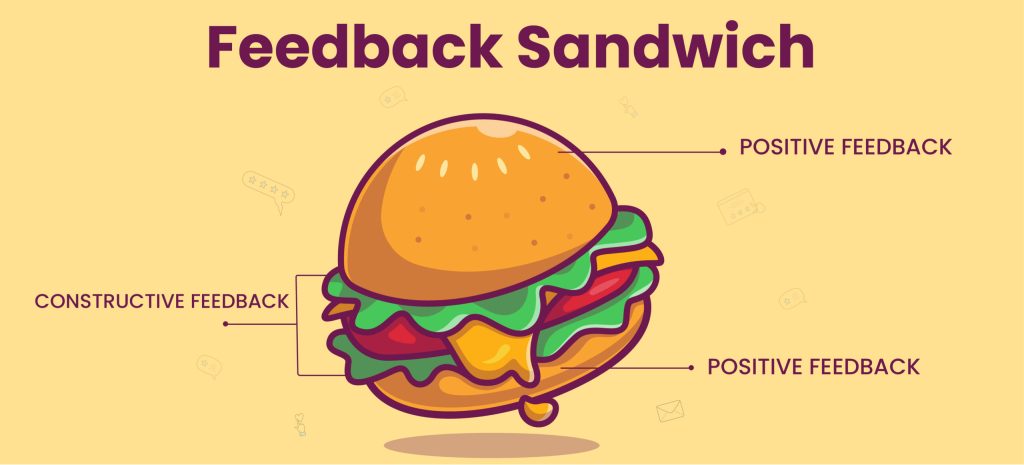
As a manager, you’ve likely delivered a “feedback sandwich”: two pieces of positive reinforcement wrapped around a thick slice of criticism. While this approach may feel like you’re softening the blow, it rarely achieves the goal of helping someone improve.

Instead, start by describing the behavior you want to correct. For example, rather than saying, “You were really rude in that meeting,” you could say something like, “I noticed you interrupted the client twice in that meeting.” Then explain the impact of the behavior so the employee knows what’s at stake. Avoid self-serving statements like “You made me look bad in there,” and focus instead on them: “You missed an opportunity to learn more about your client.”

Finally lay out what you would like them to do instead. Be specific: “Next time, if a thought comes up while the client is speaking, jot it down and wait until they finish before jumping in.” This kind of feedback is respectful, clear, and actionable, and will boost your chances of actually pushing your employee to learn and grow.