Pre and Post Mortems…

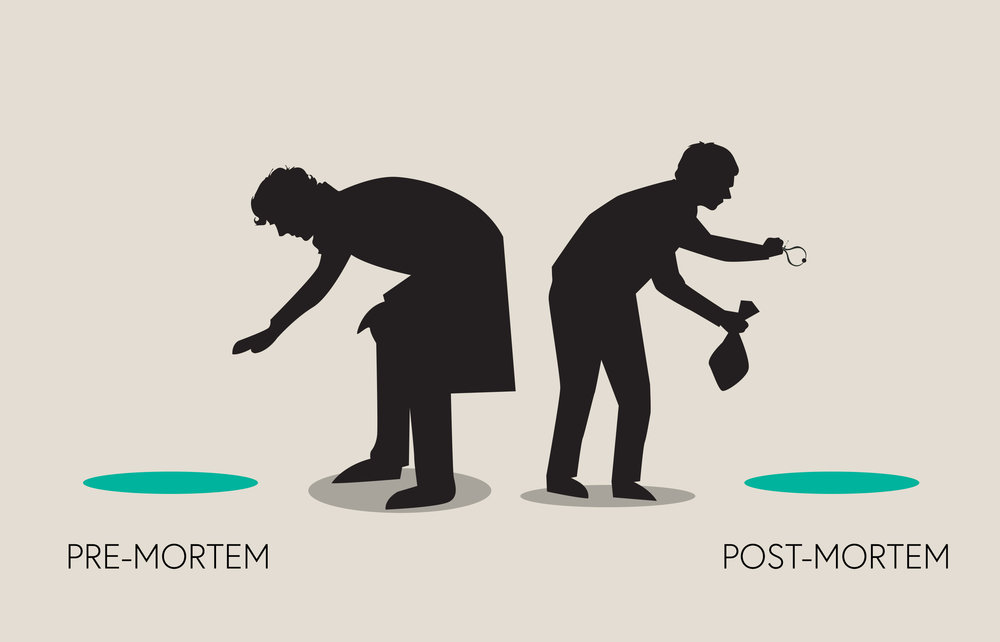
Learning about the past and inspecting the future is critical for any project. Pre and Post Mortems help us do that very effectively.

Pre-Mortem

These conversations are used to help identify and mitigate risks for specific projects, goals, or initiatives upfront. Ask your team: How can we make sure we enable the drivers that will contribute most to our success? How can we address or mitigate risks that could cause us to fail?

Post-Mortem

This is a chance to step back, take a more objective perspective, and challenge the team’s assumptions. First, focus on your successes. What went well, and what was the impact of these things going well? What behaviors, factors, or conditions contributed to their success? Then shift to failures or shortfalls. What didn’t go well, and what was the impact of these things not going well? What behaviors, factors, or conditions led to that outcome? How can we avoid these issues going forward?


Am I hard to work for?

Nobody wants to be a bad boss. Here are a few questions to help assess whether you are difficult to work with as a boss.

Are your standards unrealistic? 

Expecting excellence isn’t a bad thing. But if your standards are too high, you’re setting your team (and yourself) up to fail. Consider whether you have perfectionist habits that frequently impact your team. 

Are you a micromanager? 

Do you tell your employees exactly how things should be done, leaving no room for creativity or initiative? If so, shift your focus to outcomes. You can provide feedback and guidance along the way, but leave the process and execution to your team. In other words, don’t do the work for them.

Do you only delegate busy work? 

Everyone wants to grow, and if you raise the bar and let go of a little control, you will be surprised by how people respond. Use delegation as a tool for development.

Is your feedback overly negative? 

Aim for a 6:1 ratio of positive to negative feedback. If you don’t often deliver positive feedback, start by acknowledging your employees’ strengths and successes in a specific and timely way.

Ask these questions frequently and keep improving to become a better boss and manager.

The repetition…

One repeat in words, verbs that are not converted into actions.

The repetition of words is proof of weakness. It proves that you have not taken any action.

Hence take action and avoid the repetition of words.

Step Up…

It’s easier to step up your effort instead of pushing too hard.

If you want to learn something, step up daily, weekly, or at regular intervals. 

Give time daily and keep increasing the time in regular intervals to reach the required level.

Lost friendship…

Is friendship losing its grip?

Friendship is one of the deepest relationships and it grows mostly when you are face to face.

Long distance friendship is for a purpose and as soon as the purpose ends it shallows the relationship.

Earlier we use to meet and plan for things. Now we plan to meet.

So nothing new is lost in the world, except maybe friendship.

A line is bigger than a point…

A decision taken based on point data is not concrete. Whereas if you have data of continuous points i.e line, the decision will be more accurate.

Similarly beating yourself on point failures like not passing an exam or an interview is futile. It’s the continuous growth (line – even if it’s curvy) that matters.

Hence a line is always bigger than a point.

Follow the process…

Will it work if we follow the process? Not necessarily. 

So should we follow the process? Yes at least if we failed we have an excuse just like all others, we failed because of the process. But if it’s anyway failing, why not choose your path, and change the process, try to make it work.

Experimentation will give us better motivation to continue, even if we fail at least we tried something different, something new.