Keep Writing Simple…

When you’re writing for work, it can be tempting to rely on industry jargon or big words to puff up your ideas. But overblown language doesn’t make you sound smart, and it can be off-putting to readers.

Most people are drawn to a more conversational tone. So, choose shorter, more familiar words and explain things in a way that anyone could understand. For example, write “things that could affect the merger” instead of “issues potentially impacting the successful completion of the merger.”

Also, whether you’re writing an email or a formal proposal, make sure that your content is glanceable since it probably will be read on a screen — and these days, often a phone.
Assume that your readers will be distracted, busy, and on-the-go.

Formatting can help: Try using subheads, bullet points, diagrams, and tables to highlight your key takeaways. Short sentences and short paragraphs help too.

A good rule of thumb is “one thought per sentence.” If there are too many linked ideas in one sentence, your readers may get lost and just give up.


How to Leave Work at Work

Some jobs have very clear lines between when you’re “on” and when you’re “off.” But when you work in a role where the lines are blurred — or potentially nonexistent — it’s important to protect your non-work time.

If you feel like work is taking over most of your waking hours, start by clearly defining what “after hours” means for you. Take into account the number of hours you’re expected to work each week, as well as personal commitments like taking your kids to school, making a certain train, or attending an exercise class you really enjoy.

When do you need to start and stop to put in the appropriate amount of work time? Then, develop mental clarity about what needs to get done and when you will do it. Keep track of your tasks and plan them out. Make sure you block off time for an end-of-workday wrap-up, where you review and make sure you did everything you needed to do for the day. Lastly, communicate with your colleagues about how (or if) you want to be contacted during your off-hours. Really guard your time.

If you don’t, you won’t get the mental break that everyone needs.

Don’t Let “Perfect” Be the Enemy of “Good”

We should all strive to do our best, but if we always aim for perfection, we may blow deadlines, annoy colleagues, and miss out on opportunities.

Instead of never being satisfied with “good enough,” talk to others about their standards. What does a good job look like to boss, peers, or client? Let’s seek their feedback on expected results, costs, and timelines rather than trying to meet extremely high standards. Then check in regularly with these colleagues. Don’t wait until the project is finished, build in checkpoints where you share your progress at 50% or 80% done. Your boss or client just might tell you that the work is good enough at that point.

You can also try small experiments where you relax your standards slightly. What happened? Were your worst fears realized? Finally, consider how perfectionism impacts your relationships. Are you setting unrealistic standards for those around you? The need to have it “perfect” will often annoy others, and in extreme cases, drive them away. For their sake — and yours — let’s learn to be satisfied with good enough.

Focus on the Positives…

Any situation whether its career-related, personal or social we tend to focus on negatives.

“Oh! I don’t know this topic what will happen in Job Interview? “, “let me skip this interview”

“I am not good looking enough to meet her/him”

“My English is not good enough to speak”

There are many such statements that goes in our mind. The main reason to focus on negatives is our ego, in other terms fear of failure. It pushes us to edge, why this happens to me? “The Ego Ahem”

As an intellectual, we always turn to logic in failures while in the success we assume it’s because of self. Whereas this might not be always true.

In any environment, there will be positives and negatives, it’s our choice to focus on one. So which one to focus? Why?

There is a 50% chance of success or failure whether you select positives or negatives. Our best bet is to focus on positives because that’s where we are good at!

Also focusing on positives makes us happier and we are willing to work harder.

Hence let’s focus on positives, be happy and achieve success more often than failures.

More interesting than this…

Something is more interesting than this and it’s always true.

Whatever you’re doing.

No matter who you’re with.

Something, somewhere, is more interesting than this and now.

And it’s in your pocket.

All the time. As long as the battery lasts.

There’s an alert, a status update, breaking news. There’s a vibration or a text, just waiting. Something. Right now.

Until infinity.

Unless we choose to redefine whatever we’re doing as the thing we’ve chosen to do, right here and right now.

सुख की है चाह तो, दुख भी सहना है…

जीवन के दुखों से, यूँ डरते नहीं हैं

ऐसे बचके सच से गुज़रते नहीं हैं

सुख की है चाह तो, दुख भी सहना है!

Translation:

Do not fear sufferings and run away from the truth in life.

If you want happiness, you should also be prepared to bear suffering.

Treat happiness and suffering as opposite sides of a single coin and accept both.

Trapped Mind…

Popular belief while trapped in mind is that it’s happening only to us.

Whereas it has happened to infinite of us and will happen to infinite in the future. The reason everyone keeps talking about it is further proof of that…

If we can understand this, it allows us to change perspective and be out of it.

Also, it does not take a cosmic intervention to be out of it but our values, learning, and ability to think of new ideas. The well prepared is always out faster and faces a lesser trapped mind situation.

Hence the benefit of always learning and unlearning.

But let’s be sure any trapped mind situation is quite common so let’s not make it more than it is.

The best things in life don’t happen on a screen…

If you add up the hours you spend each day interacting with your phone, tablet, laptop, desktop or television, you may realize that you’re spending the majority of your waking life staring at a screen.

Sure, much of this screen time is useful or necessary, even sometimes enjoyable. But there are a lot of other times when our screens distract us from things that are truly important to us—whether it’s the people we love or the activities that bring us meaning and joy.

So let’s take back our lives from our screens by balancing screening time and real lifetime.

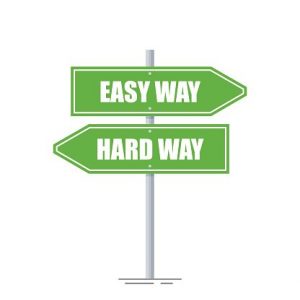
Easy choices, hard life. Hard choices, easy life…

If we are making the hard choices now then the long-term will be easy.
If we make the easy choices now, the long-term life will be a lot harder.

In what to eat, if we are not eating all the junk food and making the hard choice to work out, then the long-term life will be easy. Won’t be sick. Won’t be unhealthy.

But if we eat junk food, do not work out and take easy choices now, the long-term will be much harder for our body & mind.

The same is true of values.

The same is true of career & goals.

The same is true of saving up for a rainy day.

The same is true of our approach to our relationships.

Criticism or Praise…

If you have to criticize someone, then don’t criticize the person, criticize the general approach or criticize that class of activities.

If you have to praise someone, then always try and find the person who is the best example of what you’re praising and then praise that person, specifically.

That way people’s egos and identities, which we all have, don’t work against you, they work for you.