Perfectionism holds us back from self-improvement and courage.

Right from childhood, we seek to shield ourselves from vulnerable feelings like disappointment, hurt and diminishment. By building a wall out of our behaviors, emotions, and thoughts, we protect ourselves from the big bad world. But to live and lead with courage, as we already know, we must let ourselves be vulnerable. This means letting down our walls and recognizing protective thoughts and behaviors for the defense mechanisms they really are.
One of the most pervasive types of self-protection is perfectionism. To get success in any field, we must rid ourselves of perfectionism. To do so, let’s start by busting some of the myths around this damaging phenomenon.
Perhaps the most damaging myth of all is that perfectionism is about self-improvement and striving for excellence. But in fact, perfectionism is really about attempting to win approval. Most perfectionists are raised in environments that praise their exceptional performance, for example in athletics or school. As a result, perfectionists develop a damaging belief system that follows them into their adult lives, anchoring their whole sense of self in accomplishments and brilliant execution.
This locks perfectionists into an exhausting behavioral pattern of pleasing people, perfecting efforts, performing for others and proving themselves. People with a healthy drive for success, on the other hand, are much more self-focused and inspired by asking themselves how they can improve. It’s a stark contrast with perfectionists, who ask ‘what might others think of me?’
Significantly, leaders who armor themselves with perfectionism often assume that this way of thinking will bring them success. They couldn’t be more wrong because there is a much darker side to perfectionism, going way beyond the need to please.
Disturbingly, research shows that perfectionism is associated with addiction, depression, and anxiety. Furthermore, perfectionists are more likely to miss opportunities and experience mental paralysis that keeps them from fully engaging in life. Why? Because their fears of being criticized or not meeting the expectations of others keep them from entering the messy arena of life, where healthy competition and striving for true greatness occur.
So take off the armor of perfectionism and jump into the fray of life. You might make mistakes in the process, but you’ll gain something valuable in exchange: the courage to succeed.
6 Ways to Go from Good to Great
What we can learn from Good-to-great companies?
How does strategic management differ at good-to-great companies versus mediocre ones?
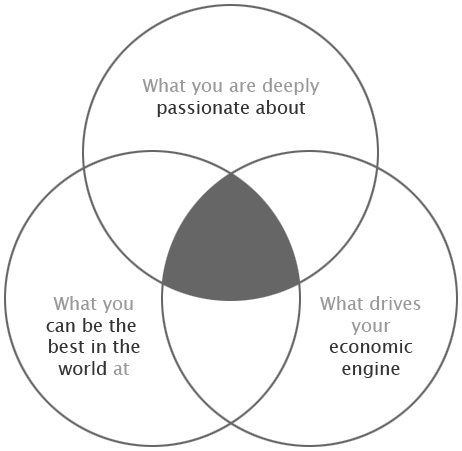
# Finding a simple “Hedgehog concept (Shaded part – Intersection of passion, skill, and economic value)“ provides a clear path to follow.
# Success comes from many tiny incremental pushes in the right direction.
# New technology should be viewed only as an accelerator toward a goal, not as a goal itself.
How do the people and culture differ at good-to-great companies versus mediocre ones?
# Team drives successful transformations from good to great. Right people in the right place are the foundation of greatness.
# Success requires confronting the nasty facts, while never losing faith. Leaders must create an environment where the brutal facts are aired without hesitation.
# A culture of rigorous self-discipline is needed to adhere to the simple Hedgehog concept.
Follow the above steps to build a great company.
Got Guilt? Use it…
Anita came late to the office and felt guilty about it? Still, she completed all pending tasks that day, came up with more ideas and achieved much more. With the baggage of feeling guilty, but determined to take action, she had a much better day than usuals.
There are numerous examples like these, where we performed much better because of feeling guilty.
Still why guilt is considered a negative emotion or a bad thing? Why shouldn’t we use it to get our determination and achieve goals?
But there are guilts like someone cheating or stealing from others, we may define as morally incorrect guilts. So let’s categorize “Guilt” as (In want of better names to Type 1 and Type 2):
#Type 1: – Less offensive Guilt: Not meeting ours or others expectations without actually doing something morally incorrect. Being late to the office, or eating more sweets or binge tv watching are the kinds of guilt which leads us feeling down but is not that big a crime.
#Type 2: – Offensive Guilt: All other types of “Guilts”, morally incorrect types, cheating or purposely hurting someone. These are the cases that come when another person is hurt or hurts the social well being and more.
We should use “Type 1 Guilt” to our advantage. In fact, sometimes it happens; we feel so guilty about not studying earlier that we put extra effort to study the whole night. So why not consciously use it to improve ourselves…
As long as we control the guilt(emotion), we can use it to help us grow…What u say?
Disclaimer: Please use this at your own risk 🙂
छिप-छिप अश्रु बहाने वालों / गोपालदास “नीरज”
छिप-छिप अश्रु बहाने वालों, मोती व्यर्थ बहाने वालों कुछ सपनों के मर जाने से, जीवन नहीं मरा करता है। सपना क्या है, नयन सेज पर सोया हुआ आँख का पानी और टूटना है उसका ज्यों जागे कच्ची नींद जवानी गीली उमर बनाने वालों, डूबे बिना नहाने वालों कुछ पानी के बह जाने से, सावन नहीं मरा करता है। माला बिखर गयी तो क्या है खुद ही हल हो गयी समस्या आँसू गर नीलाम हुए तो समझो पूरी हुई तपस्या रूठे दिवस मनाने वालों, फटी कमीज़ सिलाने वालों कुछ दीपों के बुझ जाने से, आँगन नहीं मरा करता है। खोता कुछ भी नहीं यहाँ पर केवल जिल्द बदलती पोथी जैसे रात उतार चांदनी पहने सुबह धूप की धोती वस्त्र बदलकर आने वालों! चाल बदलकर जाने वालों! चन्द खिलौनों के खोने से बचपन नहीं मरा करता है। लाखों बार गगरियाँ फूटीं, शिकन न आई पनघट पर, लाखों बार किश्तियाँ डूबीं, चहल-पहल वो ही है तट पर, तम की उमर बढ़ाने वालों! लौ की आयु घटाने वालों! लाख करे पतझर कोशिश पर उपवन नहीं मरा करता है। लूट लिया माली ने उपवन, लुटी न लेकिन गन्ध फूल की, तूफानों तक ने छेड़ा पर, खिड़की बन्द न हुई धूल की, नफरत गले लगाने वालों! सब पर धूल उड़ाने वालों! कुछ मुखड़ों की नाराज़ी से दर्पन नहीं मरा करता है!
Scattered Priorities
Scattered Priorities is one of the biggest hindrances in achieving success, as they say, “If you have more than 3 priorities than there are no priorities”.
It’s true not only as leaders, managers or entrepreneurs but at our personal level as well. Think about it when u have tried to accomplish too many things nothing happens.
So why do we do it? Why we set ourselves for failure aiming too many things to achieve? Here are few:
1. Our Fear of Failure or Insecurity:
To safeguard ourselves from failure we build a facade of different priorities or tasks. But imagine the fallacy of this, if you fail in your prime task or priority, is it not better to fail and try again, than to compromise? As said, “There is no reason to have Plan B because it distracts from Plan A“.
2. Lack of Self-Believe:
We do not want to commit to one thing, as we are in self-doubt. It might be because of what others think about us or past failures or lack of determination to make it happen.
3. Too many options leading to indecision:
Sometimes we get too many choices to decide and instead of taking the time to decide, we pick 2 or 3 options and start running with it.
4. Smart-A** expects as s/he can do 10 things together, so can the team or subordinates:
This is true for leaders, entrepreneurs, and managers. They think that since they can design, review business, talk sales simultaneously hence everybody should do 5 things together.
It’s a big fallacy since the leader would have reached this level of productivity in the field with almost 10+ years of experience or more. Expecting same with the team is sure recipe for failure. A team should have a coherent goal and corresponding set of tasks to be achieved. Just to keep them busy with more tasks helps to do nothing.
What else do you think leads us to scatter ourselves and setting for failure? Please share your thoughts in comments
Thinking is an addiction
Here is the definition of “Addiction” – “the fact or condition of being addicted to a particular substance or activity.”
In the case of “Thinking“: Mind’s condition of “nonstop thinking” is an addiction.
How much thinking we do on daily basis? Look at the hours we spent on thinking about oneself, what we did, what shouldn’t do, what we had done, how we can change this, what others are thinking about us. Blah, Blah, Blah…Mind just keeps rambling about all the things, true, untrue and more…
How can we stop thinking and start doing actions? Maybe cut the thoughts and just live the moment. Why shouldn’t we set hours, do things, to act, without thinking, without judging?
Imagine how a child interacts with surroundings without thinking and enjoying everything, this is one of the reasons children can do a lot of activities without even getting tired once, but we over think everything and get addictive to use similar like other addictions like food and alcohol, although for this an Addiction Treatment Rehab Centre can help us. If you need CBT for addiction, visit the Cocaine Rehab Centre to get the treatment you need.
Thinking drains so much of our energy, as it drags us to mindless loop and specifically if its negative or worrisome thoughts? How can we get rid of these looping thoughts of negativity or worrying?
I think (What a dilemma I am still thinking :)) We can accomplish a lot of things if we just take up actions, without thinking and blocking ourselves. What do you say?
Parenting…
Parenting is often a rinse and repeat of this scenario: “Ideas you have about how it should be, combined with what experience is telling you to do, overlaid with too many options and chronic exhaustion.”
Let’s look at different ways in which we can make it bit easy and more accessible to be doing it:
#Adaptation: We all know the meaning of Adaptation:-“Species Adapt to Change”. As a parent, we have this notion of following a righteous path and giving no room for change. If our child has to sleep at 10:30 she has to sleep at 10:30 period. Maybe this notion came from peers or our own ideas to be disciplined? Why not adapt based on our child, based on the situation. Every child has different needs and it changes very drastically with their age.
We can get out of this type of thinking if we reframe ‘changing’ as ‘adapting’. And stop critisizing ourselves for our inevitable parenting mistakes, to get out of the no-point comparisons with our peers, and to give us the freedom to make changes depending on the situation.
#Bigger Picture: Yes, I know what bigger picture got to do with Parenting? Think about it what is it we want our children to learn? Most importantly – To be successful in life or may be to be successful in studies, career or sports. Or you might have some bigger dreams for them.
Now if your child is not cleaning her room, or keeps a messy room. But good in studies and shown a keen interest in chess. Instead of badgering every day for messy room, can’t we find a middle territory and let them be for these lesser things.
At the end what we want is for them to come to us for help when life gets really complicated? If yes then we need to focus on behaviors that will allow having that strategic influence on them. Making them feel crappy every day because the shirt is not matching with pants or because all the Pokemon cards are on the floor, isn’t going to cut it. Make no mistake, letting go of smaller things is not about throwing out all the rules. This is about knowing which battles to fight, so you can keep the middle territory of the trust and respect with your child.
#Removing obstacles, doing less of: Its not always about finding solutions, but sometimes about reducing obstacles. When it comes to parenting, we need to ask ourselves not only what we could be doing more of, but also what we could be doing less of.
When my friend was going on month number nine of her baby waking up four times a night, she felt at her wits’ end. She had been trying different techniques and strategies, thinking that there was something she wasn’t doing right. When nothing seemed to be working, she stopped trying to add elements like new tactics and changed her strategy. She looked instead for obstacles to remove. Was there anything preventing the baby from sleeping through the night?
The first night she made it darker. No effect. The second night she made it warmer. Her son has slept through the night ever since. It wasn’t her parenting skills or the adherence to a particular sleep philosophy that was causing him to wake up so often. Her baby was cold. Once she removed that obstacle with a heater the problem was resolved.
We do this all the time, trying to fix a problem by throwing new parenting philosophies at the situation. What can I do better? More time, more money, more lessons, more stuff. But it can be equally valuable to look for what you could be doing less of. In so doing, you may enrich your relationships with your children immeasurably.
With these let’s try and to be more successful in our Parenting, Happy Parenting to you!
Please share your thoughts or comments below.